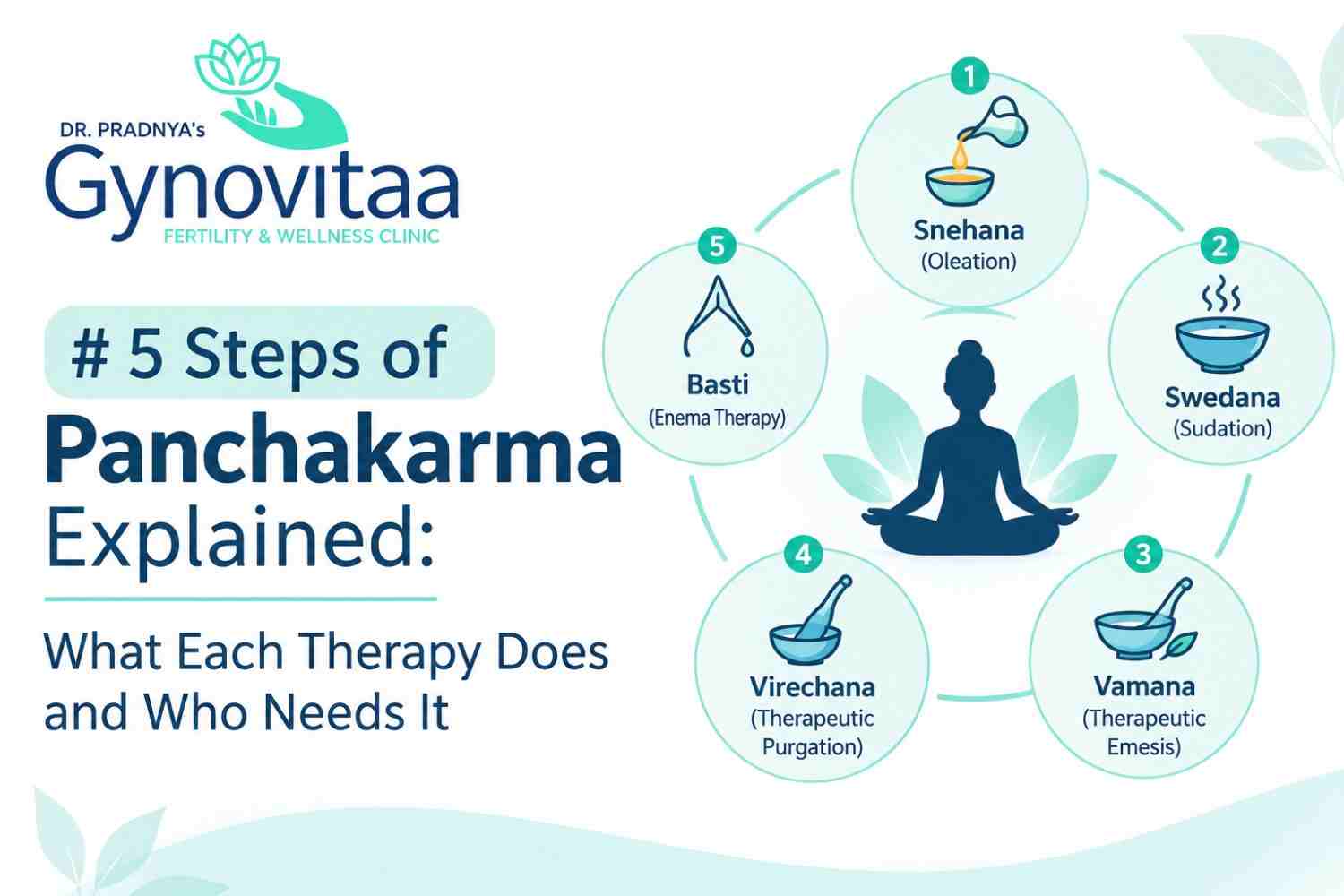
The 5 steps of Panchakarma are Vamana (therapeutic vomiting), Virechana (therapeutic purgation), Basti (medicated enema), Nasya (nasal therapy) and Raktamokshana (controlled bloodletting). Together they are called Pradhana Karma, the main cleansing therapies. Your doctor usually picks one or two of them, not all five, and places them between a preparation phase and an aftercare phase.
Key takeaways
- Panchakarma means “five actions”. The five are options to choose from, not five stages you pass through in order.
- Vamana works on Kapha, Virechana on Pitta and Basti on Vata. Nasya treats the head and neck. Raktamokshana is used only in selected cases.
- Every course has three phases: Purvakarma (preparation), Pradhana Karma (the main therapy) and Paschat Karma (aftercare).
- Panchakarma is a medical treatment, not a spa detox. It needs a qualified Ayurvedic doctor and is not suitable during pregnancy.
Research on Panchakarma, especially for hormones and fertility, is still limited. Be careful with anyone who promises a cure.
If you have read about Panchakarma online, you have probably seen the number five and wondered whether you are expected to go through all five. You are not. The word is Sanskrit for “five actions”, and those actions are a set of options. A doctor chooses from them after examining you.
This guide explains the 5 steps of Panchakarma in plain language: what is done in each one, which problems it is usually meant for, and who should stay away from it. It is written by the team at Gynovitaa Fertility & Wellness Clinic in Balewadi, Pune, where Ayurvedic Consultant in Baner Dr. Pradnya Dole uses Panchakarma alongside Ayurvedic gynaecology and women’s health care.
What are the 5 steps of Panchakarma?
The 5 steps of Panchakarma are Vamana, Virechana, Basti, Nasya and Raktamokshana. Ayurveda calls them shodhana, which means cleansing. Each one is meant to remove accumulated toxins (ama) and excess dosha through the nearest natural route in the body.
Therapy | What it is | Main focus | Route | Commonly considered for |
Vamana | Therapeutic vomiting with herbal medicines | Kapha | Mouth (upper tract) | Allergic rhinitis, asthma, some skin conditions, Kapha-type weight gain |
Virechana | Therapeutic purgation with herbal medicines | Pitta | Bowel (lower tract) | Hyperacidity, liver and digestive problems, eczema, psoriasis, acne |
Basti | Medicated enema, with decoction or with oil | Vata | Colon | Joint and back pain, sciatica, constipation, nerve-related problems |
Nasya | Herbal oil or medicine given through the nose | Head and neck | Nose | Sinusitis, migraine, headache, stress, hair fall |
Raktamokshana | Removal of a small, controlled amount of blood | Pitta and blood (rakta) | Skin or vein | Chronic skin conditions, localised inflammation, recurrent boils |
Classical texts do not agree on every detail. Charaka lists Vamana, Virechana, the two types of Basti (Niruha with decoction and Anuvasana with oil) and Nasya. Sushruta includes Raktamokshana as a fifth therapy. Many clinics today teach the list of five used above.
Are the 5 steps of Panchakarma done one after another?
No. The five therapies are alternatives, not a sequence. A typical course uses one or two of them, chosen for your condition, your body type, your age and strength, and the season. Someone with chronic sinus trouble may be advised Nasya. Someone with long-standing hyperacidity may be advised Virechana. Many people are never advised Raktamokshana at all.
What does happen in order is the three-phase structure around the main therapy:
- Purvakarma (preparation): oleation and herbal steam to loosen toxins and make the body ready.
- Pradhana Karma (main therapy): the Vamana, Virechana, Basti, Nasya or Raktamokshana your doctor has chosen.
- Paschat Karma (aftercare): a graded diet, herbs, rest and follow-up so the body settles properly.
What happens before the main therapy (Purvakarma)?
Before any of the five, the body is prepared with oleation (Snehana) and herbal sweating (Swedana). Snehana can be external, as in Abhyanga, a medicated oil massage. It can also be internal, where you take medicated ghee in slowly increasing doses over several days. Swedana uses herbal steam to open the channels and bring toxins towards the digestive tract.
Preparation usually takes from a few days to about a week, depending on the therapy and the person. Skipping it is one of the main reasons unsupervised “detox” programmes go wrong.
Step 1: What is Vamana therapy?
Vamana is therapeutic vomiting. It is used to clear excess Kapha from the stomach, chest and upper airways. After preparation, you are given a herbal preparation in the morning, usually on an empty stomach, which brings on controlled vomiting. The doctor watches your pulse, blood pressure and general response throughout.
Usually considered for: allergic rhinitis, asthma, chronic cold and congestion, certain skin conditions and Kapha-type weight gain.
Who should avoid it: as a general rule, pregnant women, very young children, frail or elderly people, and those with heart disease, uncontrolled high blood pressure or a bleeding disorder. Classical texts place Vamana in spring, when Kapha naturally builds up.
Step 2: What is Virechana therapy?
Virechana is therapeutic purgation. It clears excess Pitta from the liver, gall bladder and intestines through the bowel. After internal oleation and steam, you take a herbal purgative in the morning. You will pass loose stools several times over the day, so it is planned for a day when you can rest at home.
Usually considered for: hyperacidity, liver and digestive disorders, eczema, psoriasis, acne and some hormonal complaints linked to Pitta imbalance.
Who should avoid it: pregnant women, people who are very weak, and anyone with acute diarrhoea or dehydration. Classical texts place Virechana in autumn, when Pitta tends to be high.
Step 3: What is Basti therapy?
Basti is a medicated enema, and Ayurveda gives it a special place among the five. Vata, the dosha behind movement, nerve function and the lower abdomen, is believed to sit mainly in the colon, so treating the colon is considered the most direct way to settle it.
There are two main types. Niruha (or Asthapana) Basti uses a herbal decoction. Anuvasana Basti uses medicated oil. They are often given alternately as a course of several sittings, and your doctor will give you a schedule.
Usually considered for: joint pain, back pain, sciatica, constipation, nerve-related problems and Vata-type gynaecological complaints such as period-related lumbar pain.
Related procedure: Uttar Basti places medicated oil or ghee through the genital route. It is a separate procedure used in Ayurvedic gynaecology for selected uterine and tubal concerns, and it is done only by a doctor after reviewing your reports.
Who should avoid it: as a general rule, pregnant women (for ordinary Basti), and people with acute diarrhoea, active rectal bleeding or severe weakness. In women, the timing is often planned around the menstrual cycle.
Step 4: What is Nasya therapy?
Nasya is the administration of medicated oil, ghee or herbal liquid through the nose. The nose is considered the doorway to the head in Ayurveda, so this therapy is used for problems above the collarbone. A Nasya session begins with a gentle face and neck massage and steam. The drops are then placed in the nostrils while you lie with your head slightly tilted back. Avoid cold air and dust for the rest of the day.
Usually considered for: sinusitis, migraine, recurring headache, allergic rhinitis, stress, brain fog and hair fall. A short course of several days is common.
Who should avoid it: pregnant women, and anyone with fever or an acute cold. Nasya is not given straight after a meal, and many doctors avoid it during menstruation.
Step 5: What is Raktamokshana?
Raktamokshana is the controlled removal of a small amount of blood to treat conditions Ayurveda links with blood and Pitta imbalance. Depending on the problem, it may be done by venepuncture (Siravedha), leech therapy (Jalaukavacharana), superficial incisions or cupping. It must be performed by a trained practitioner using sterile, single-use equipment.
Usually considered for: chronic skin conditions, localised inflammation and recurrent boils.
Why it is the least used of the five: it is only suitable for a narrow set of conditions, and it is not a routine part of most Panchakarma plans. At Gynovitaa, it is considered only when it is clinically appropriate.
Who should avoid it: people with anaemia or a bleeding disorder, anyone taking blood-thinning medicines, pregnant women and those who are very weak.
What happens after the five therapies (Paschat Karma)?
After the main therapy, your digestion is weak and needs to be rebuilt slowly. This is done through Samsarjana Krama, a graded diet that starts with thin rice water and gradually moves back to normal food over three to seven days. After that comes Paschat Karma proper: a suitable diet, herbal medicines, yoga and breathing practices, good sleep, stress management and follow-up visits.
This phase largely decides how much benefit lasts. Going back to your usual routine on day one can undo much of the work.
How are the 5 steps of Panchakarma used in women’s health?
In Ayurvedic gynaecology, Panchakarma is usually a preparation for herbal treatment, or a support alongside it, and not a stand-alone cure. The therapies are matched to the pattern of imbalance:
- Virechana may be considered for Pitta-type complaints, including some irregular-cycle and hormonal patterns.
- Basti may be considered for Vata-type complaints such as period pain, lower back pain and pelvic heaviness.
- Uttar Basti may be considered for selected uterine and tubal concerns.
- Nasya may be used where headache, stress or disturbed sleep accompany a hormonal problem.
Dr. Pradnya Dole uses these therapies for women with PCOS and PCOD, irregular periods, menstrual pain and in preparation for pregnancy, after assessing each patient individually. You can read more in our article on how Panchakarma supports hormonal balance.
It is fair to be clear about the evidence. A 2026 narrative review on Panchakarma in preconception care, published in the Journal of Clinical and Diagnostic Research, noted that scientific evidence for its use in reproductive health is scarce and that more research is needed. Panchakarma should sit alongside proper medical evaluation, not replace it.
Who should not do Panchakarma?
Panchakarma is not safe for everyone, and the decision belongs to your doctor. As a general rule, it is avoided or modified for:
- Pregnant women
- People who are very weak, severely underweight or recovering from surgery or a long illness
- People with heart disease, uncontrolled high blood pressure or uncontrolled diabetes
- People with anaemia or a bleeding disorder, especially for Raktamokshana
- Anyone with fever, acute infection or acute diarrhoea
- Children and older adults, who are assessed case by case
Tell your doctor about every medicine you take, including blood thinners and diabetes medicines. Never stop a prescribed medicine on your own during or after Panchakarma.
How long does a Panchakarma course take?
A full Panchakarma programme at our clinic generally runs between 7 and 21 days, and the length is always individual. It covers preparation, the main therapy and the start of aftercare. Shorter sessions may be suggested for preventive wellness. Your doctor will give you a written schedule after the first consultation.
How do you know which of the five steps you need?
You find out through a proper consultation, not by choosing a therapy from a menu. The doctor reviews your history, symptoms, reports, daily routine and body constitution (Prakriti). Nadi Pariksha, the Ayurvedic pulse assessment, is often part of this.
A good consultation ends with a clear plan: which therapies, why those, how long, and what you should not do. A good doctor will also tell you when Panchakarma is not right for you. If you are comparing clinics, our guide on how to choose a Panchakarma doctor in Pune lists what to look for.
About Ayurvedic Consultant in Baner Dr. Pradnya Dole and Gynovitaa Clinic
Ayurvedic Consultant in Baner Dr. Pradnya Dole is an Ayurvedic gynaecologist and the founder of Gynovitaa Fertility & Wellness Clinic in Balewadi, Pune. She has more than 17 years of experience and has practised in India, Dubai and Indonesia. Her qualifications include BAMS, a Fellowship in Gynecology & Infertility, a Master of Ayurvedic Dietetics and an MSc in Psychology.
Her work covers PCOS and PCOD, irregular periods, endometriosis, thyroid concerns and fertility care for women and men, with Panchakarma, diet and lifestyle guidance used where they are appropriate. To see how the programme works at the clinic, read about our Panchakarma treatment in Pune.
Frequently asked questions about the 5 steps of Panchakarma
1. What are the 5 steps of Panchakarma?
They are Vamana (therapeutic vomiting), Virechana (therapeutic purgation), Basti (medicated enema), Nasya (nasal therapy) and Raktamokshana (controlled bloodletting). They are preceded by a preparation phase and followed by an aftercare phase.
2. Do I have to do all five?
No. Your doctor chooses the therapy or therapies that match your condition, body type, strength and the season. Most people are given one or two, and many are never advised Raktamokshana.
3. Is Panchakarma painful?
Most of it is gentle: oil massage, steam and rest. Vamana, Virechana and Basti can leave you tired or uncomfortable for a day, which is why they are done under observation and followed by rest.
4. Can I do Panchakarma during periods or pregnancy?
Not during pregnancy. During periods, it depends on the therapy. Nasya is often avoided, and Basti and Uttar Basti are usually planned around the cycle. Your doctor will time the course for you.
5. How often should Panchakarma be done?
Some classical texts suggest seasonal cleansing for healthy people, but it is not needed every season by everyone. How often you should do it is a decision for your doctor.
6. Is Panchakarma the same as a detox spa?
No. Panchakarma is a medical treatment planned after an Ayurvedic consultation, using prescribed medicines under a doctor’s supervision. A spa massage or steam session is not a substitute.
7. Can Panchakarma cure PCOS or infertility?
There is no proven cure. Panchakarma may support treatment for some women alongside Ayurvedic medicines, diet and medical evaluation, and research in this area is still limited.
8. Can I go to work during Panchakarma?
It depends on the therapy. Many people manage during preparation and Nasya. Vamana, Virechana and Basti days usually need rest, and your doctor will advise on this.
Book a Panchakarma consultation in Balewadi, Pune
If you would like to know which of the 5 steps of Panchakarma suits you, book a consultation with Ayurvedic Consultant in Baner Dr. Pradnya Dole.
- The clinic is at Sai Ankur, A401, opposite F-Residences, Balewadi, Pune 411045.
- Call or WhatsApp +91 88559 55508,
- Email: gynovita.pune@gmail.com, or use the contact page.